



Wonders of Stone and Silence: Italy's Most Beautiful Villages in Salento
Among the secret wonders of Salento lie small, suspended worlds, where stone tells age-old stories and every alley holds a fragment of eternity. These are not simply tourist destinations, but places of the soul: Presicce, Specchia, Otranto, and Maruggio, recognized among the "Most Beautiful Villages in Italy," offer a journey through time, amid Baroque and Byzantine architecture, olive trees whispering in the wind, and living traditions.
 International tourists imagine Italy as a place of cultural refinement. Our ancient history, scenic beauty, and artistic treasures are the true wealth of our country. Many of the artistic and cultural sites are found in the smallest and least-known towns: the "Most Beautiful Villages in Italy" Association represents the best that Hidden Italy has to offer the world.
Founded in 2002, the Association promotes small towns that have preserved their beauty and authenticity. With over 360 selected and certified villages, the Association promotes sustainable economic development combined with the protection of historical, artistic, and environmental heritage.
The "Quality Charter" defines the criteria for membership and the methods for awarding the label, a guarantee of excellence and authenticity. Certified villages become top-rated tourist destinations, helping to promote a "local tourism" that is aware and respectful of local cultures.
The Association relies on a robust communications network: an annual guide with 50,000 copies distributed, a website with over 1,500,000 unique visitors annually, and social media with more than 2 million followers. The English version of the guide—"The Most Beautiful Villages of Italy"—is designed to promote "roots tourism" and engage an international audience.
Numerous annual events enliven the villages, including the Romantic Night in the Villages of Italy, the National Village Festival, and the Mediterranean Conference. Since 2019, the Association has been ISO 9001 certified for the promotion of national cultural heritage. It also founded the International Federation "Les plus beaux Villages de la Terre" (The Most Beautiful Villages of the Earth) to share and promote the value of these outstanding villages worldwide.
Presicce: The City of Olive Oil and Hypogea
 Presicce, in the heart of lower Salento, is a refined and surprising town, known as the City of Olive Oil and the City of Hypogea. Here, everything revolves around the "yellow gold": extra virgin olive oil.
The underground olive oil mills, true underground cathedrals of rural civilization, can be visited in Piazza del Popolo, Vico Sant'Anna, and Via Gramsci. The historic center is an enchanting labyrinth of courtyards and cobbled alleys: don't miss the "li vecchi curti" in the Corciuli and Padreterno districts, with the ancient courtyard houses in Via E. Arditi, Vico Matteotti (1581), Vico Sant'Anna, and Via Anita Garibaldi.
On the Pozzomauro hill stands the small rural church of the Madonna di Loreto, of Basilian origins, next to which lies a Byzantine crypt converted into an olive oil mill.
The surrounding area is dominated by fortified 16th-century farmhouses (La Casarana, Del Feudo, and Tunna) and 18th-century villas, such as Casina degli Angeli (1778) and Casina Celle. A visit to the Museum of Rural Life (Piazza del Popolo) is a must, housing around 300 tools from Salento's rural life.
Presicce captivates with its historic center dotted with Baroque palaces, such as Palazzo Alberti, rich in Neapolitan majolica, and the majestic Palazzo Ducale, with its medieval turret. The churches, including the Mother Church of Sant'Andrea Apostolo, the Church of Carmine, and the Church of the Angels and the Dead, reveal a valuable artistic heritage. The Casa Turrita (or Torre di San Vincenzo) is emblematic, one of the oldest fortifications in the village.
Specchia: The Noble Sentinel of Capo di Leuca
 Specchia, nestled among the rolling hills of Capo di Leuca, is one of the most picturesque villages in lower Salento. Its name derives from the ancient
 "specchie," piles of stones used as observation points. Perched on a hill, Specchia dominates the surrounding landscape with a sober and noble beauty.
Specchia's history is marked by great feudal families, from the Del Balzo to the Gonzaga, and by epic sieges such as that of 1435. Its architecture recounts its past with palaces and castles: above all, Risolo Castle, the Protonobilissimo Risolo Palace, and the Ripa Palace with its frescoed loggia.
The village is a maze of artisan workshops, cobbled alleys, and historic homes: Palazzo Teotini, Palazzo Coluccia, Orlando Pisanelli, and Orlando Pedone are testaments to a glorious past.
Specchia is also a land of artisanal traditions: wrought iron, terracotta, olive wood, and rush are still crafted using ancient techniques.
Nearby, the Terra di Leuca offers natural beauty, sports, and hiking trails. For information, the GAL Capo Santa Maria di Leuca is the right place to organize authentic itineraries.
Otranto: The Pearl of the Orient
 Otranto is the gateway to the East, the easternmost point of Italy, steeped in history and culture. Its origins date back centuries: inhabited since the
 Bronze Age, it was an important port for the Messapians, and later a flourishing Roman, Byzantine, and Norman city.
The Old Town is a maze of narrow streets that wind around the Porta Alfonsina, the Aragonese Castle, and the Norman Cathedral, with its famous Tree of Life mosaic and the crypt housing the relics of the 800 martyrs beheaded by the Turks in 1480.
The small Church of San Pietro, with Byzantine frescoes, and the Palazzo Lopez (now the Diocesan Museum) complete an itinerary that alternates mystical inspiration and artistic beauty.
Otranto is also a vibrant town: the Aragonese walls, artisan shops, seaside bars, and summer events (such as the Medieval Days) make the city lively and welcoming. Its center is a place where history and modernity coexist harmoniously.
Maruggio: Between the Sea, Baroque, and Knights
 Maruggio, on the Ionian coast of the province of Taranto, is a village with a unique history: founded between the 9th and 10th centuries, it was ruled by the Templars and then by the Knights of Malta for over five centuries.
The historic center, known locally as "schiangài," is an enchanting maze of streets, with whitewashed houses, noble palaces, baroque loggias, and flower- filled balconies. Among its iconic sites are the Palazzo dei Commendatori (or Castle of the Knights), the Chiesa Matrice (15th century), the Torre dell'Orologio (Clock Tower) with its war memorial, and the evocative Chiesa di San Giovanni fuori le mura (Church of St. John Outside the Walls), originally intended to accommodate the sick and pilgrims.
Maruggio is also nature: the Campomarino Dunes, up to 12 meters high, are part of the Regional Nature Reserve and protect one of Salento's most beautiful coastlines, with white beaches and crystal-clear sea. The surrounding countryside is dotted with ancient farmhouses and the original Maruggio trulli, dry-stone dwellings made of white stone.
The local forests (Pindini, Sferracavalli, and della Maviglia) offer hiking trails immersed in the Mediterranean scrub, amidst the scents of myrtle, mastic, and juniper.
A Slow Journey Through Culture and Beauty
Presicce, Specchia, Otranto, and Maruggio represent four distinct souls of Salento, yet all united by a profound and authentic charm. These villages are best explored at a leisurely pace, savoring the sun-warmed stone, the freshness of the olive trees, and the embrace of the sea. They are ideal destinations for those seeking timeless beauty, where Italy is still poetic.

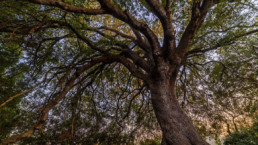
The Green Giants of Salento: When Trees Become Monuments and Architecture
"Trees are poems that the earth writes in the sky." — Kahlil Gibran
The tree represents the bond between earth and sky, between matter and spirit, between nature and beauty. It is a silent, visible poem that speaks to us without words. In Salento, this silent and ancient wealth is hidden, which rises majestically between stone and sky: monumental trees. True arboreal patriarchs, they are not only witnesses of time and history, but become protagonists of a cultural landscape where nature and architecture blend in a harmonious balance. Legends, science, spirituality and a deep bond with the identity of the territory are intertwined in these trees.
Trees as architectural elements: nature incorporated into living
In Salento, monumental trees do not live on the margins of architecture: in many cases they are an integral part of it. In farmhouses, historic gardens, villas and urban spaces, the tree is designed as a living structure, a vegetal column that dialogues with arches, pergolas and courtyards. Examples include the centuries-old olive trees embedded in the dry stone walls of the Strudà and Vernole countryside, or the fig trees or holm oaks that, in the cloisters of former convents or in Italian gardens, mark out the space as columns would in a basilica. In Lecce, in the courtyard of the former Conservatory of Sant’Anna, a 25-meter ficus macrophilla towers among the baroque arches: it is not just a natural element, but an integral part of the architectural scenography.

The Vallonea oak of Tricase: symbol of Salento
Among the most famous monumental trees in Italy is the Vallonea oak of Tricase, planted about 900 years ago and today the guardian of an evocative legend: it is said that in the 12th century it offered shade and shelter to Frederick II and his one hundred knights marching towards the Crusades. 19 meters high, with a crown that covers over 500 square meters, this oak is a witness to the transition from the medieval forestry world to the modern agricultural landscape.
Perhaps imported by the Basilian monks from Dalmatia, the Vallonea oak is today a living natural monument, part of the Otranto–Santa Maria di Leuca Regional Park, and a true emblem of the harmonious interaction between man and nature.
The Araucaria of Taurisano: ornamental exoticism in the Salento villa
In the town of Taurisano, in Villa Lopez, two majestic examples of Araucaria of Queensland, originally from Australia, stand out. Planted in 1880, over 24 meters tall with a base circumference of 4.30 meters, they represent an emblematic case of trees imported to decorate private parks and noble villas, according to a typical taste of the nineteenth-century bourgeoisie. Their presence testifies to the decorative and symbolic function of trees in the historic Salento architecture, in which real acclimatization gardens were created for rare exotic species.

Fitolacca di Veglie: when nature shapes space
In the courtyard of the Masseria La Zanzara in Veglie, now restored but dating back to 1471, grows an enormous Fitolacca dioica, an ornamental tree native to South America. With a crown with a diameter of 17 meters and a base almost 18 meters wide, this tree, planted in 1780, is an integral part of the structure of the masseria. Its central position is strategic: it protects from the sun, offers a meeting point, designs the space. A fascinating example of the intersection between historical architecture and botanical landscape.
The Chilean Palms in Sannicola: plant architecture and colonial memory
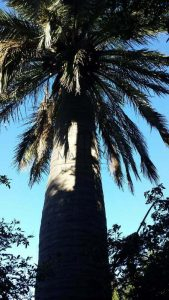
At Villa Starace in Sannicola, the entrance avenue is flanked by five Chilean Palms, 15 meters high. Fruits similar to small coconuts, imposing trunks and tropical silhouettes: these trees, imported from the Andes in the 19th century, transform the outdoor space into an exotically inspired garden. They represent the memory of a time when the Salento landscape was contaminated with overseas suggestions, often translated into architectural elements such as greenhouses, pergolas and orangeries.

The Ficus of Lecce: a green column between baroque and spirituality
In the heart of Lecce, near the former Conservatory of Sant’Anna, stands a 250-year-old ficus macrophilla. Planted in the 19th century, it is a rare case of perfect fusion between monumental trees and urban context. The building, designed to host religious women and noblewomen, welcomes this green giant that seems to want to touch the clouds. It is a symbol of naturalistic spirituality, where the tree becomes almost a symbolic elevator upwards, pushing the gaze beyond the roofs and baroque vaults.
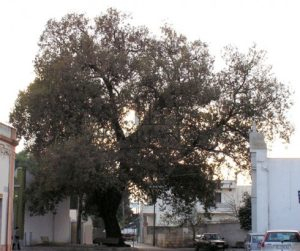 The holm oak of Lizzanello and the oak of Taurisano: relics of ancient forests
Among the native species, the monumental holm oak, called the "Leccio dei Briganti", of the Pisignano district (Lizzanello), stands out, 23 meters high with a crown that measures 27. Witness of the Mediterranean forests that once covered Salento, it is one of the last giants that survived urbanization and land consumption. Similar is the case of the Virgilian oak of Taurisano, which extends from one side of via XXIV Maggio to the other, incorporating the road and the houses in a green embrace.

Centuries-old olive trees: roots that tell the story of time
No article on the monumental trees of Salento could ignore the centuries-old olive trees, true natural monuments that dot the region with their gnarled trunks. In Borgagne, Vernole, Strudà, Casarano and Alliste there are specimens with evocative names: Lu Matusalemme, Il Re, La Regina, La Testa, La Cascata. Some are more than 3,000 years old and continue to produce olives, from which the DOP extra virgin olive oil “Terra d’Otranto” is obtained. They are living sculptures, witnesses to the resilience of a land that has been able to transform the olive tree into a symbol of identity.
Tree Hugging and the Return to Contact

In Salento, home to ancient and majestic trees, the practice of tree hugging is becoming more and more widespread, an ancient ritual now rediscovered in a therapeutic way. Sitting at the base of an oak, breathing under a holm oak or meditating next to an olive tree is not only an ecological choice but also a gesture of deep connection with nature, which many choose to do in the woods of Tricase, in Pisignano or in the gardens of historic farmhouses.
A heritage to be censused and protected
Since 2015, a national decree has required Italian municipalities to census monumental trees, recognizing the environmental, historical and cultural value of these green giants. Citizens, schools and associations can report notable specimens. A simple gesture, which however protects a fragile and invaluable heritage. In Salento, doing so means preserving not only nature, but the very identity of the territory.
Conclusion: living architecture between heaven and earth
In Salento, monumental trees are not just “nature”, but living architecture, silent columns that support the memory of a territory and dialogue with the constructions of man. They are guardians of beauty, but also of balance: between concrete and green, between past and future. And today more than ever, they remind each of us that the landscape is not something to admire, but something to inhabit with respect.

Puglia Dream: Salento Wins the Blue Flag 2025
Every year, with the arrival of spring, anticipation grows for the announcement of the new Blue Flags—the prestigious international award given to coastal locations that stand out for the quality of their waters, services, and environmental care. The year 2025 has been particularly positive for Puglia, which confirms and strengthens its presence on the national scene, with several Salento locations in the spotlight.
But what exactly is the Blue Flag? What’s its history? And why is it so important—not only for sea lovers, but also for local communities and the regional economy?
The Origins of the Blue Flag
The Blue Flag was established in 1987 by the FEE (Foundation for Environmental Education), an independent international organization based in Denmark. Its goal—then and now—is to promote environmental sustainability in coastal municipalities by encouraging administrations to improve land management, water cleanliness, and the quality of services offered to residents and tourists.
Over the years, the award has gained increasing importance, becoming an international benchmark for those seeking environmentally responsible seaside destinations. Today, the Blue Flag is awarded in over 50 countries worldwide and represents a symbol of reliability, safety, and respect for nature.
Criteria for Earning a Blue Flag
Earning this recognition is no easy feat. Locations must meet numerous requirements that go far beyond scenic beauty or crystal-clear waters. Key criteria include:
-
Excellent bathing water quality, verified by constant and rigorous monitoring.
-
Sustainable land management, with a focus on recycling, wastewater treatment, and protection of local ecosystems.
-
Accessibility and safety, with equipped beaches, lifeguards, and facilities accessible to people with disabilities.
-
Environmental education, promoted through activities, information boards, and awareness campaigns for both residents and visitors.
Participation in the program is voluntary, but the selection process is strict: every application is thoroughly reviewed, and only those that meet all requirements are allowed to hoist the coveted flag.
Puglia Among the Sea Queens of 2025
With its long coastline bathed by both the Adriatic and Ionian Seas, Puglia has long been one of Italy’s most awarded regions by the FEE. In 2025 as well, the region not only confirmed but increased the number of Blue Flag destinations, placing it among the top regions in Italy for certified beaches.
Twenty-two Puglian municipalities were awarded the distinction, covering the entire coastal area from north to south—a testament to a widespread commitment to environmental protection and quality tourism.
Salento in the Spotlight: All the Awarded Locations
Within this virtuous context, Salento plays a leading role. A land of olive trees, stone, and crystal-clear waters, Italy’s “heel” received multiple awards recognizing not only the beauty of its landscapes but also the increasing environmental awareness of local governments.
Among the Salento towns awarded the 2025 Blue Flag are:
-
 Otranto, with its iconic beaches and constant efforts to enhance the coastline.
-
Melendugno, which retained the flag thanks to its seaside areas of Torre dell’Orso, Roca, and San Foca.
-
Salve, whose “Maldives of Salento” have long been a model for balanced tourism management.

-
Gallipoli, which, despite being a mass tourism hotspot, has managed to protect parts of its coastline.
-
Nardò, with its seaside areas of Santa Caterina and Santa Maria al Bagno, confirmed for their quality and services.
-
Santa Maria di Leuca, a 2025 new entry, receiving the Blue Flag for the first time—marking the results of recent work on environmental care, accessibility, and sustainable coastal use.
-
Tricase, also a first-time recipient, rewarded for its efforts in redeveloping its wilder, more authentic coastal spots like Marina Serra.
Beyond Tourism: The Blue Flag’s Impact on the Territory
 The Blue Flag is more than just a symbolic honor—it brings real, often significant, benefits. For tourists, it’s a guarantee of quality and an added reason to choose a destination. But its impact reaches further.
Over time, the award has shown a direct effect on the real estate market: certified areas tend to experience increased demand—from both vacation home seekers and forward-looking investors. A well-maintained, clean, and valued territory naturally attracts both Italian and foreign capital.
Additionally, the Blue Flag encourages eco-conscious practices among tourism businesses, leading to greater adoption of renewable energy, plastic reduction, and landscape preservation initiatives.
A Commitment Looking Toward the Future
The success of 2025 confirms that the path taken by Puglia and Salento is the right one. The Blue Flag is not a finish line, but an ongoing commitment—a challenge renewed each year that requires collaboration, vision, and respect for a unique land.
Looking ahead, it will be essential to continue this journey by involving citizens, local governments, tourism operators, and investors in a shared vision of sustainable development. Because a cleaner sea, a more accessible coastline, and more mindful management are not just environmental goals—they are the beating heart of a new economy: fairer, healthier, and more beautiful to live in.

Salento protagonist of regenerative tourism: Travel Hashtag 2025 lands in Martano
On May 13 and 14, 2025, the heart of Salento will host an international event of great significance: the first Italian edition of Travel Hashtag, the traveling format that for the past six years has made stops in some of the world’s most iconic destinations to explore new tourism trends.
 This twentieth edition will take place in the stunning setting of an exclusive resort in Martano—an authentic masseria (traditional farmhouse) nestled in nature, a symbol of discreet luxury and deep respect for the land. The location was chosen deliberately to focus on rural, regenerative, and sustainable tourism, with notable guests from both Italy and abroad. The event is held in media partnership with DOVE and under the patronage of ENIT, Pugliapromozione, the Province of Lecce, the Municipality of Martano, and the Italian Ministry of Tourism.
Rural Tourism and Real Estate: New Opportunities for Salento
The event aims to showcase Salento as a model of regenerative tourism—one that enhances the identity of places and creates well-being for both travelers and local communities. This approach has direct benefits for the real estate sector, as demand increases for masserie, rural homes, historic dwellings, and countryside properties renovated with authenticity and sustainability in mind.
 More and more investors, both Italian and international, are looking for properties in Salento to turn into experiential tourism residences, charming agritourism spots, boutique hotels, or prestigious private homes. This trend aligns perfectly with the Travel Hashtag philosophy: authentic, land-connected experiences, far from mass tourism.
An Event Focused on the Future of Tourism (and Living)
The two-day program will include themed conferences, talks, networking sessions, and testimonials from those who have already made Salento a premier destination.
Among the expected guests: prominent institutional figures, representatives from travel media, business executives, university professors, tourism marketing experts, hospitality consultants, destination managers specializing in inland areas, and professionals in wellness, digital detox, and territorial development.
Key topics:
-
“Return to the Essentials” – regenerating places and people
-
“Respect the Land, Cultivate the Future” – agriculture and tourism as allies
-
“Disconnection Tourism” – reconnecting with yourself in nature’s silence
-
“Rural Tourism: Valuable and Authentic Experiences” – a winning model for Salento
-
“Puglia: Territory, Opportunity, Attractiveness” – perspectives on local development
-
“Regenerative Tourism for a New Social Wellbeing” – the role of quality hospitality
 Why This Event Also Matters to Homebuyers and Investors
Travel Hashtag 2025 shines a light on a new way of living, inhabiting, and investing in Salento. It's not just about traveling—but about building meaningful connections with the land, choosing properties that tell a story, that respect the environment, and that offer authentic experiences.Whether you're looking for a second home surrounded by greenery, dreaming of opening a charming hospitality business, or simply wanting to live closer to nature—Salento today is fertile ground, in every sense of the word.
The growing attention to regenerative tourism and rural area promotion is making this region increasingly attractive from a real estate investment perspective as well. A home here is not merely a material asset—it’s a cultural, social, and human value.
Conclusion
Travel Hashtag 2025 is a key moment to reflect on the future of tourism—and of living—in Italy. And it does so by choosing Salento: a land of tradition and innovation, of authentic beauty and genuine hospitality. A territory that once again proves to be at the center of the map for those looking ahead.To explore our real estate offerings in the heart of Salento, contact us: whether you want to live here, invest, or simply slow down, we can help you find the perfect place to call home.

The Marine Protected Areas of Salento and Their Relationship with Architecture and Construction: A Fragile Balance Between Conservation and Development
The Salento: Enchanting Coasts and the Challenge of Sustainability
The Salento, with its enchanting coasts washed by the Ionian and Adriatic Seas, has always been a territory that fascinates with its natural beauty and historical heritage. In this corner of Puglia, the Marine Protected Areas (MPAs) play a fundamental role in safeguarding marine and coastal ecosystems, while at the same time posing delicate challenges for architecture and construction, which must balance environmental protection with the growing demand for sustainable development. This article explores how the Salento’s MPAs interact with urban planning and architecture, focusing on possible solutions to preserve the integrity of the territory without compromising the region's economic and tourism dynamism.
What is a Marine Protected Area?
A Marine Protected Area (MPA) is a specific area of the sea and its coasts that is subject to special protection measures to safeguard natural habitats, marine biodiversity, and endangered species. MPAs are managed through specific regulations, which may include restrictions on human activities such as fishing, navigation, and construction, with the goal of reducing human impact on the marine and coastal environment. In Italy, the MPA system is an essential tool for protecting the natural marine heritage, and Salento is home to some of the most significant marine areas in the Mediterranean, attracting millions of visitors every year.
Marine Protected Areas of the Salento
The Salento, with its rich biodiversity and breathtaking landscapes, is dotted with MPAs that, besides being places of exceptional ecological value, play a central role in the region's tourism landscape.
 Marine Protected Area of Porto Selvaggio
This MPA is one of the most significant examples of the beauty and ecological importance of the Salento. Located in the Nardò area, just a few steps from the natural park of Porto Selvaggio, this area protects a stretch of coast rich in Mediterranean scrub, sea caves, and crystal-clear waters. The area hosts a wide variety of marine species, including fish, mollusks, and occasionally dolphins.
The architecture developed around Porto Selvaggio is highly respectful of the environment. Modern buildings harmonize with the landscape, using natural materials such as Lecce stone and favoring architectural solutions that minimize visual and environmental impact. The buildings are designed to blend into the surrounding landscape, leveraging natural light and energy efficiency to reduce the use of non-renewable resources.
Marine Protected Area of Santa Maria di Leuca – Capo di Leuca
Santa Maria di Leuca, located at the southernmost tip of the Salento peninsula, represents another area of great interest among the region’s MPAs. Here, the sea meets history, traditions, and local culture. The protected area includes a wide range of marine habitats, from cliffs to Posidonia oceanica meadows, which are essential for biodiversity conservation.
Urban planning regulations in Santa Maria di Leuca are particularly stringent and greatly limit new constructions along the coast. This ensures that building development is responsibly directed, avoiding the construction of invasive structures that spoil the panoramic view. In this sense, the concept of "landscape architecture" is fundamental to urban planning, focusing on the restoration of old rural structures and promoting tourism that respects the environment.
 Marine Protected Area of Torre Guaceto
Located between Brindisi and Ostuni, Torre Guaceto is one of Puglia’s most important nature reserves. Characterized by salt marshes, sandy dunes, and crystal-clear waters, this area serves as a refuge for numerous species of migratory birds and marine fauna. The presence of extensive Posidonia meadows, among the largest in the Mediterranean, is crucial for coastal protection and marine biodiversity conservation.
In Torre Guaceto, land management focuses on enhancing local traditions and restoring rural architecture. The buildings, mostly restored from old farms and trulli, are integrated into the surrounding landscape, with particular attention to the use of eco-compatible materials and building techniques that minimize environmental impact. Restoring historic buildings helps maintain the connection with local tradition, while environmental respect promotes sustainability.
1. Rauccio Regional Natural Park
The Rauccio Natural Park, located in the Salento hinterland, is an area of particular ecological importance. Although it is not a marine area, the park protects numerous natural habitats, such as wetlands and Mediterranean scrubland. The park's management focuses on protecting native fauna and flora, but the surrounding areas are also subject to building restrictions to ensure that urban development does not compromise the integrity of the ecosystem.
2. WWF Le Cesine Oasis
Le Cesine is one of the most evocative natural oases in Salento, a wetland that is home to a rich variety of wildlife. The oasis is particularly important for the protection of migratory birds and endangered species. The area has been preserved from invasive building development, and the territorial planning of the surrounding areas includes the protection of the natural landscape and the promotion of eco-sustainable tourism.
3. Ugento Coastal Park
The Ugento Coastal Park is a nature reserve that extends along the Ionian coast of Salento and includes an important maritime and coastal area. Characterized by sand dunes, pine forests and cliffs, this park is essential for the conservation of natural habitats and for the protection of marine and terrestrial species. Here too, urban planning regulations aim to limit construction, encouraging redevelopment of existing structures and sustainable tourism development.
4. Punta Pizzo Park
Punta Pizzo is a protected area overlooking the Ionian Sea, known for its natural beauty and crystal clear waters. The area is ideal for the protection of dunes and Posidonia meadows, and is a popular destination for ecotourism activities such as birdwatching. The park was established to preserve the integrity of the marine and coastal environment, limiting the construction of new buildings and encouraging the adoption of architectural solutions that are in harmony with the surrounding natural environment.
 5. Palude del Capitano Park
The Palude del Capitano is a wetland of ecological importance, which represents a precious habitat for many species of migratory birds and for the typical vegetation of the Salento marshes. In this area, urbanization is strictly controlled to protect the ecosystem and prevent irreversible damage to natural resources. The park, although not a marine area, is fundamental for the management of water resources and the conservation of the landscape.
Other Parks and Natural Areas of the Salento
Besides the aforementioned MPAs, Salento boasts other protected areas that are crucial for preserving local biodiversity and maintaining unspoiled coastal landscapes. These parks, although not necessarily marine protected areas, also contribute to environmental protection and impose building restrictions to prevent damage to the natural ecosystem.
Architecture and Construction in the Context of Marine Protected Areas
The MPAs of Salento place a strong emphasis on sustainability and responsible management of natural resources. However, the relationship between MPAs and architecture is not without tension, as building expansion and the growing demand for tourist facilities put pressure on environmental protection regulations. To balance the need for development with nature conservation, it is essential to adopt a sustainable building model that respects the specific characteristics of the coastal landscape.
Sustainable Tourism and New Architectural Solutions
Sustainable tourism is one of the main tools to ensure the protection of MPAs. Tourist facilities must harmoniously integrate with the environment, avoiding the construction of invasive buildings that could alter the landscape. In this regard, eco-compatible architecture plays a key role. Buildings near MPAs must meet low environmental impact criteria, such as using natural materials and renewable energy sources.
A significant example is the emergence of eco-resorts in Salento, designed to be energy self-sufficient and to minimize the use of natural resources. These structures not only offer a tourist experience respectful of the environment but also a development model that can be replicated in other marine protected areas.
Requalification and Recovery of Existing Buildings
Requalifying existing buildings, rather than constructing new ones, is one of the most effective solutions to reduce environmental impact. In many Salento MPAs, the restoration of historic buildings, such as trulli, masserie, and abandoned houses, has been encouraged as part of a heritage enhancement program. This approach not only preserves the historical memory of the area but also allows for new tourist facilities in already developed contexts, avoiding building speculation on untouched land.
Conclusions
The marine protected areas of Salento are a valuable heritage that deserves to be preserved for future generations. The relationship between environmental protection and building development is complex but can be managed with innovative and sustainable solutions that promote a balance between conservation and progress. MPAs, along with other parks and nature reserves in the region, offer a unique opportunity to develop tourism that respects the environment while promoting economic growth and enhancing natural resources.

BIT Milano 2025: Lecce and Salento on the rise, record tourism and a buoyant real estate market
Lecce, one million visitors in 2024: Puglia makes its way into foreign markets
 International tourism continues to drive Puglia's growth, making it one of the most sought-after destinations in Italy. At the Borsa Italiana del Turismo (BIT) 2025 in Milan, encouraging data were presented that confirm the positive trend: arrivals in the region in 2024 reached 6 million (+10.6% compared to 2023), while attendances almost reached 21 million (+9.7%). The data relating to foreign visitors is impressive, having increased by 22% compared to the previous year, reaching a share of 40.5% of total arrivals.
Puglia increasingly an international brand
A concept also reiterated by Rocco De Franchi, head of institutional communication for the Puglia Region, who
highlighted how the challenge was to transform the region into a globally recognizable brand.
«Today Puglia is no longer a collection of 250 bell towers, but a community that presents itself compactly to the world. Our strength is that of a people who work with determination to always improve», declared De Franchi.
A success that, as underlined by the Gazzetta del Mezzogiorno, is the result not only of public policies, but also of the ability of private operators to make the most of European funds and to build quality tourism offers.
Lecce on the rise: one million visitors
The capital of Salento has recorded record numbers with 375,484 arrivals and over 1 million visitors (+23% compared to 2023), surpassing Vieste and positioning itself in second place among the most visited destinations in Puglia, immediately after Bari. The significant increase in visitors testifies to the growing attractiveness of the city, which combines historical heritage, food and wine offerings and a renewed interest in experiential tourism.

Architecture and the real estate market: new investment opportunities
The tourism boom in Lecce has a direct impact on the real estate sector, with a growing demand for second homes from Italian and foreign investors. The Lecce Baroque, which embellishes palaces and churches, has become a major attraction for international buyers looking for exclusive residences. The real estate market sees an increase in interest in historic buildings to be renovated and transformed into luxury accommodation facilities, B&Bs and boutique hotels.
In recent years, the historic center of Lecce has attracted significant investment, with many buildings converted into charming homes. Demand is mainly supported by French, German, Swiss and English buyers, but also by Americans, fascinated by the authenticity and quality of life offered by Salento.
The strategic role of experiential tourism
Data analysis shows that tourists no longer limit themselves to visiting Lecce and its province in the summer months, but also choose the city in spring and autumn. Cultural events, food and wine tours and the possibility of exploring the region with a slow approach make the destination increasingly attractive. Roots tourism, which aims to rediscover one's Italian origins, is emerging as a growing market segment, especially among Italian-Americans.
Salento protagonist at BIT 2025
During the BIT in Milan, South Salento presented itself as a single tourist destination under the new brand "South Salento: a range of emotions", which enhances the diversity of the territory through three symbolic colors: the green of nature, the red of culture and the blue of the sea. This approach aims to strengthen the competitiveness of the region at an international level, focusing on an integrated tourist offer that includes historic villages, nature trails and slow tourism.
At the fair, tour operators specialized in incoming showed a strong interest in authentic experiences, from trekking on the ancient pilgrim routes to tastings of typical products. The demand for luxury stays is growing, with a preference for renovated farmhouses and historic residences.
Conclusions
Lecce and Salento are confirmed among the most sought-after destinations in Puglia, thanks to an effective tourism strategy and an expanding cultural and real estate offer. The growing presence of foreign tourists represents a decisive boost for the local economy and the real estate market, with increasingly interesting opportunities for those who want to invest in this land rich in history, beauty and authenticity. The future of tourism in Puglia appears bright, with Lecce ready to play a leading role.
HyperRegionalism: Lecce between layers of history and futuristic visions
In October 2024, Lecce hosted the thirteenth edition of “Architects Meet”, an event conceived by AIAC (Italian Association of Architecture and Criticism), in collaboration with the Municipality of Lecce, the Polo Biblio-Museale and the Order of Architects PPC of Lecce. The theme chosen for this edition, “HyperRegionalism”, materiality and immateriality of Architecture”, explored a contemporary trend that contrasts global homogeneity with a rooted and recognizable architecture, capable of combining technological innovation and local tradition.
The concept of “HyperRegionalism” is based on a new balance between traditional and advanced technologies, with a particular focus on sustainability and energy efficiency. As underlined by the architectural critic and historian Luigi Prestinenza Puglisi, president of AIAC, the theme represents a response to standardization: “We recover significant fragments of pre-existing structures to create a dialogue between old materialities and new immaterial flows.”
The days of the event saw the involvement of architects, critics and designers from all over Italy and abroad, who shared projects emblematic of this vision.
Lecce, chosen for its unique architectural heritage, was the ideal setting for the event. The main venues, including the Teatro Paisiello, the Biblioteca Bernardini and the Church of Santa Maria di Ogni Bene, hosted conferences, exhibitions and meetings, creating an immersive experience for participants.
 Manuel Aires Mateus, an internationally renowned Portuguese architect, received the International Award “Architects Meet in Lecce 2024”. During his lectio magistralis at the Teatro Paisiello, he illustrated the restoration project of Torre 67 in Alezio, an example of how the recovery of the past can coexist with sustainable contemporary design.

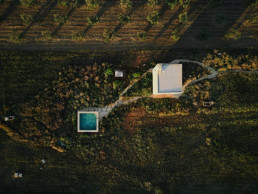
Along the dry stone walls of a narrow country lane in Southern Salento, you reach Torre67, Mateus’s first project in Puglia. The tower, with a square plan and structured on two levels, rises in the heart of the rural area of Alezio (Lecce). Immersed in a landscape of crops, vineyards and wild flowers, two olive trees marked by Xylella welcome the entrance, like columns that evoke the memory of a now lost landscape. Built between the 12th and 14th centuries, initially intended for sighting purposes, the tower has undergone several transformations over time, maintaining traces of religious symbolism. Today, thanks to the rigorous restoration work of the Portuguese studio, the tower returns to its original form.
The restoration, completed in 2024, was based on the enhancement of the historical value of the site, with the aim of returning the tower to its original structure. The intervention involved the elimination of additional bodies and highlighted the tuff walls and the original openings. A radical approach, given that the tower is not constrained and that part of the demolished structures have not been rebuilt, but reused to create new components: the swimming pool, with a shape that replicates the tower, and the paths in the surrounding landscape.
 The building was transformed into a residence for two clients from Milan who chose to live in Puglia. The living area is on the ground floor, while on the first floor there is a bedroom, a bathroom and a small office. All the rooms are characterised by traditional vaults and floors in cocciopesto, beaten tuff and travertine, while the walls are finished with lime and hemp. The choice to fully preserve the structure, the use of local and natural materials for the furnishings and the absence of air conditioning and heating systems are the most radical aspects of the project. The thermal inertia of the walls and natural ventilation partially compensate for the lack of cooling and heating systems.
This transformation represents an example of slow, almost monastic living, which distances itself from the frenetic pace of modern life and rediscovers values of the past, not only aesthetic but also linked to direct contact with the territory.
The project is part of a particularly current context in Puglia, where many historic buildings are being restored and transformed into homes or accommodation facilities, also thanks to the support of regional funds. In this region, the design rooted in the territory, which preserves historical memory, contrasts with the growing demand for comfort and high energy performance, a theme that was the subject of discussion during "Architects Meet” in Lecce.
The event was enriched by two exhibitions curated down to the smallest details:

 - “HyperRegionalism”, curated by Riat Archidecor, presented over 100 projects by Italian studios, enhancing the relationship between historical pre-existences and innovative architectural solutions. The installation
was composed of wooden tables, then handcrafted with an ecological decorative paint in different shades of color, supported by some very essential iron elements. The tables hosted about 140 notebooks, each of which illustrated a project created by an architectural studio. The theme of the exhibition is Hyperregionalism: to an architecture without a soul, the same in all places, today we try to contrast spaces that are rooted and recognizable and constructions in which the material plays a leading role.
- “Supermostra 24”, curated by Ilaria Olivieri and Luigi Prestinenza Puglisi, an observatory and a traveling exhibition explored the work of 33 emerging designers, with the aim of verifying how much interest is happening in the field of architecture in the different regional areas of the peninsula, inaugurating the “STELO” exhibition system, an innovative project of the Polo Biblio-Museale of Lecce.
With over 600 registered attendees, “Architects Meet 2024” ended with an extremely positive balance. “We have laid the foundations for a profound reflection on the future of Italian architecture,” said Prestinenza Puglisi. The event transformed Lecce into an international capital of architecture, consolidating its role as a point of reference for contemporary architecture and for the dialogue between tradition and innovation.
The theme of HyperRegionalism, which explores an architecture in harmony with the local context, focused on the specificities of Salento, such as the use of Lecce stone and carparo. These materials were valorized as examples of sustainability and architectural innovation.
With an international participation of over 300 professionals and scholars, the event strengthened the visibility of Lecce and Salento, positioning them as a cultural and tourist center for architecture.
The event confirmed Lecce as a laboratory of architectural innovation, combining historical memory and contemporaneity. These annual meetings, if continued, will further consolidate the identity of Salento as a model of sustainable development based on the valorization of its unique resources.

The Porto Selvaggio Regional Natural Park
Ten kilometers away from the Municipality of Nardò and a little less than twenty from the Municipality of Gallipoli there is an obligatory stop for those visiting Salento: a natural oasis that includes the Cala di Porto Selvaggio, the Palude del Capitano and the Torre dall 'Alto, a natural area protected by regional law since 2006 and included in 2007 in the list of "100 places to save" of the Italian Environment Fund (FAI).
We said an obligatory appointment, for lovers of seaside resorts, sports and nature in general. You can get there by driving a few minutes from the Municipality of Nardò and after having parked in one of the stops used, you walk a few hundred meters and find yourself in front of a natural spectacle to rub your eyes, a long descent immersed in nature leads in fact to a small beach of gravel and pebbles with a crystalline sea, whose waters are particularly refreshing and invigorating, also due to a current of fresh and cold water that reaches directly into the bay. The beach is surrounded by a large pine forest, whose trees were planted in the 1950s to reclaim the largely marshy surrounding land.
Within this natural park, which is not limited to the beach area, but includes over four hundred hectares of land, of which over two hundred and sixty of pine forest, there are various itineraries and different possibilities to relax or play sports; there are in fact the surrounding cliffs, a little more inaccessible than the "pine forest area", but which still allow bathing, there are also the numerous paths inside the pine forest, usable for walks or picnics and which are also an unmissable appointment for lovers of trekking and mountain biking. Speaking of trekking, among the most remarkable views of the park, returning to Gallipoli, you can go up along the pine forest and admire the Tower of Santa Maria from the High, an ancient watchtower, located 50 meters above sea level, on a rocky spur overlooking the beach, from which you can enjoy a breathtaking view of the entire natural park. The tower was erected in the second half of the 16th century and was part of an elaborate system of defensive turrets spread over the entire Salento coast, communicating to the north with Torre Uluzzo and to the south with Torre Santa Caterina. This system of turrets represents a historical heritage of the Salento area, but in a certain sense it is also an emotional heritage for the local population, as each of these turrets marks the landscape of the Salento coast in a unique way, we will talk about it in more detail with another article on this blog.
Speaking of history, the Porto Selvaggio Natural Park, in addition to the landscape treasure and the possibilities for sports of various kinds, also offers unmissable opportunities for archeology enthusiasts: eight different archaeological sites in the cave have been identified within the park , a sign of presence first by Neanderthal groups and subsequently by Sapiens, and the territory of the Municipality of Nardò is the center of an extraordinary "district of prehistory", with a historical stratification ranging from Neanderthal and Sapiens frequentations to those left by Messapi and then later by the Romans, up to the baroque architecture of the historic center of the same municipality. The Museum of Prehistory of Nardò, located in the former convent of Sant’Antonio da Padova, preserves most of the finds from archaeological research conducted in the area.
This wonderful natural oasis is located on the side of the Salento coast that faces west and therefore those who are there at sunset will see the sun slowly sink into the sea, we therefore recommend that you end your day in Porto Selvaggio with an aperitif in one of the numerous bars or kiosks between the natural oasis and Gallipoli, you will end a simply perfect day at the beach.

The sentinels of Salento: the history of the coastal towers
The coast of Salento always offers a remarkable panoramic spectacle, whether you go up it towards the north of the region from the eastern part or towards the city of Taranto from the western Ionian part, or that you descend it towards the Capo di Leuca, the beauty of the glimpses is always worthwhile and it is difficult to resist the desire to stop and enjoy the view of the sea, the golden sunrises or the fiery sunsets.
Those familiar with these splendid landscapes will have noticed that there are often stone turrets, or the remains of these, to shore up these views, as if they had been placed there for aesthetic reasons, as if to act as a vertical counterpoint on the mainland to the horizon. fixed of the sea. They almost represent milestones in the economy of the landscape, they also constitute an emotional heritage for the local population that associates with the surrounding marinas, so much so that some of these towers over time have become part of the Salento toponymy, even if officially as a "locality", often these towers indicate places of their own, for an inhabitant of the area going to Porto Miggiano is different than going to Santa Cesarea Terme, despite Porto Miggiano being a "locality" of the Municipality of Santa Cesarea Terme.
But what do we know about these towers? When were they built and for what reason? It is interesting to answer these questions because the answers tell us a lot about the history of Salento and more generally of all of Southern Italy. The construction of coastal towers has an essentially military reason, they have always been primarily outposts for sighting and defense from the incursions of enemy armies or "pirates", those of which traces remain on the territory or in historical documents all date back to medieval times, although it is probable that some of them were also built in previous eras, but no trace remains of these, those that remain visible today date back either to the years of the 11th century or, in most cases, to the years between XVI and XVII centuries, the years in which Don Pedro Álvarez de Toledo y Zúñiga reigned over all of Southern Italy as Viceroy of the Kingdom of Naples, on behalf of Charles V of Habsburg.
The first coastal towers in Southern Italy were therefore built in the 11th century to defend the territories from pirate raids, but due to the continuous political changes that never allowed a stable administration of the territory, a real integrated and functioning defense system on the whole coast was never finished and the few towers built ended up becoming the property of local families, who used them to defend and guard their possessions exclusively. Things changed in the mid-fifteenth century, when the raids on the Italian territory of pirates and especially of the Ottoman invaders became more and more frequent, in fact the capture of Otranto by the Ottoman invaders dates back to the year 1480, who in reaching the Salento town did not they found practically no resistance, above all they were able to land on the Salento territory without being sighted and therefore without anyone notifying the citizens of Otranto.
Just following the tragic event, Don Pedro de Toledo, who became Viceroy of the Kingdom of Naples in 1532, decided to implement and operate the system of control turrets, which had to be enough to be able to monitor the entire coast of Southern Italy and since the the main danger was the increasingly powerful Ottoman Empire and therefore it came from the East, it was Salento, due to its exposed geographical position, that was at the center of this surveillance system. This type of enterprise, that is the construction of over 300 coastal towers, for the canons of the time was not at all trivial, also for a matter of costs, so the towers were often built with a rather innovative "procurement" system for the time , or rather the construction was entrusted to a private individual who in exchange for the work could boast the military title of "Captain of the tower". There was no shortage of unforeseen events, for example in some cases these private individuals, despite the precise indication of the Viceroy to use fresh water for the processing and laying of materials, used the salt water of the sea to save costs, but the towers built with the salt water suffered from erosion and collapsed in no time. Despite these unforeseen events, the work was slowly completed and the Kingdom of Naples suffered the Ottoman advance with less and less damage, until the decisive battle of Lepanto in 1571 averted the Ottoman danger for our coasts forever.

The heritage of architectural eclecticism in Salento: the Moorish palaces
In architecture, “eclecticism” is defined as a current that aims at mixing the best stylistic elements present in the various architectural movements. The movement was born in England in 1700, then in the following century it spread widely to the rest of Europe, eventually reaching southern Italy as well. In its initial phase, European architectural eclecticism drew its ideas from different historical periods, with the birth of neo-Greek architecture, followed by the neo-Renaissance and then by the neo-baroque, but over the years the interpreters of eclecticism sought the their inspiration not elsewhere in time but in space, in the architecture of distant and exotic places, hence the Neo-Moorish and Neo-Egyptian architecture, but there was also no lack of Chinese and Indian influences.
What we will look at more closely is the neo-Moorish style, which left splendid traces in the Salento peninsula, but which arrived in the West primarily in France, following Napoleon's expedition to Egypt in 1798, and later developed in England and in other European countries, also due to colonialism in the East. Among the most distinctive elements of Moorish architecture we note the presence of circular domes, generally surmounted by a pointed spire, the use of bright colors and a large amount of intricate decorative motifs.
One of the most shining examples of this style in Salento is undoubtedly Villa Sticchi in Santa Cesarea Terme, a splendid building set in one of the most beautiful corners of the entire southern coast of the Adriatic, majestic and immediately recognizable even from far away, for reasons functional as well as aesthetic: the imposing central pagoda, in fact, which makes its profile so unmistakable, at the time was also designed to reflect the sunlight and become a beacon for ships sailing off the coast. This private residence can be considered a real icon of the local area, it was completed in 1894 on the ambitious project of the engineer Giuseppe Ruggeri, who signed many other Moorish residences on the two coasts of Salento, including the one he occupied as his own residence. in Leuca, or Villa La Meridiana, with an octagonal plan and also unmistakable from the outside due to its lively red and yellow parallel bands.
Another very interesting case is that of the “Eclectic Villas of the Cenate”, which take their name from the place where they were built, the Cenate in fact. These stately villas were designed and built between the end of the nineteenth century and the beginning of the next, in the midst of the "eclectic period" and we can admire them on the roads that lead from Nardò to the marinas of Santa Maria al Bagno and Santa Caterina. Walking or cycling through these country roads suddenly, in the middle of the characteristic olive trees, these precious baroque villas appear, in Art Nouveau style or even here in neo-Moorish style, as in the case of the beautiful Villa Saetta (now De Michele) and Villa Cristina dei Personè (now De Benedittis).
This desire to experiment and enrich the local landscape with exotic motifs and shapes was not limited to the coast but also took hold in the city of Lecce, only that while for the summer residences you could indulge yourself in the decorations, especially with the colors, city eclecticism took on less pronounced tones. In Lecce, however, there are some examples of nineteenth-century villas resulting from the architectural eclecticism of the period, almost all along the avenues created at the end of the nineteenth century in place of the newly demolished sixteenth-century walls. Interesting for the variety of architectural characters is Villa Bray, in neo-Moorish style, with an inscription in Arabic characters under the cornice, decorated with horizontal yellow and red bands: on the first floor the windows have horseshoe arches, on the second the arches are Byzantines, on the pointed arch gate. Villa Indraccolo also has oriental-style decorations. Another example of eclecticism declined according to local taste is Villa Himera, whose friezes are carved in Lecce stone.